Fire Retardant vs Fire Resistant Sandwich Panels: Understanding the Difference
Fire Retardant vs. Fire Resistant: Understanding the Difference in Building Materials and Sandwich Panels
The terms Fire Retardant and Fire Resistant are often used interchangeably in the construction industry. However, from an engineering perspective, they describe two fundamentally different concepts.
Understanding the distinction is essential for engineers, consultants, contractors, and project owners when selecting materials that meet fire safety requirements.
What Does Fire Retardant Mean?
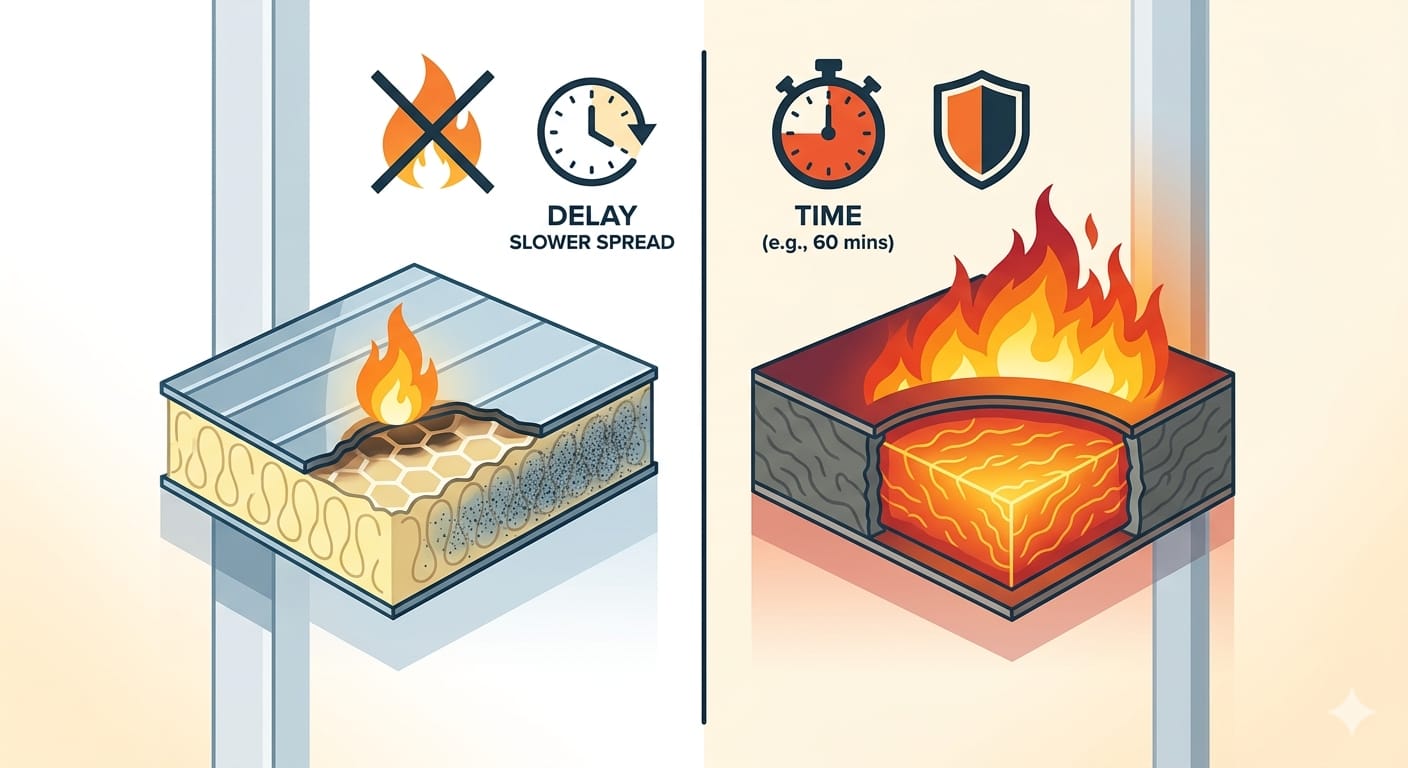
A Fire Retardant material is designed or treated to slow down ignition and reduce the rate at which flames spread.
These materials do not completely prevent combustion, but they delay ignition and help limit fire growth when exposed to a heat source.
Key Characteristics of Fire Retardant Materials:
- Slows flame spread.
- Delays ignition.
- Provides additional time for evacuation and firefighting.
- Does not guarantee fire resistance for a specific period.
Examples of Fire Retardant Materials:
- Fire-treated wood.
- Flame-retardant fabrics.
- Certain EPS, PUR, and PIR products containing fire-retardant additives.
Practical Example:
A Fire Retardant material may still ignite when exposed to direct flame, but the fire will spread more slowly compared to a conventional material.
What Does Fire Resistant Mean?
A Fire Resistant material or assembly is specifically designed and tested to withstand fire exposure for a defined period while maintaining its integrity and intended function.
Fire resistance ratings are typically expressed in time periods such as:
- 30 minutes
- 60 minutes
- 90 minutes
- 120 minutes
- 240 minutes
Key Characteristics of Fire Resistant Materials:
Withstands fire for a specified duration.
Limits heat transfer.
Maintains structural performance during fire exposure.
Verified through standardized fire testing.
Examples of Fire Resistant Systems:
- Fire-rated doors.
- Fire-rated walls.
- Fire-rated ceilings.
- Fire-resistant cable systems.
Practical Example:
A 60-minute Fire Resistant Door can prevent the passage of flames and excessive heat for approximately one hour under standardized testing conditions.
Fire Retardant vs. Fire Resistant Sandwich Panels:
When selecting Sandwich Panels for industrial facilities, warehouses, and commercial buildings, understanding this distinction is critical.
1- Fire Retardant Sandwich Panels:
These panels contain a core material with reduced combustibility or fire-retardant additives designed to slow flame propagation.
Common Examples:
- EPS Fire Retardant Panels
- PIR Fire Retardant Panels
- Certain PUR Panels
Common Classifications:
EN 13501-1: B-s1,d0
EN 13501-1: C-s2,d0
ASTM E84: Class A
These classifications describe the reaction of the material to fire but do not indicate fire resistance for 60, 90, or 120 minutes.
2- Fire Resistant Sandwich Panels:
These panels are tested as a complete Panel Assembly to verify their ability to prevent the passage of flames and heat for a specified duration.
Most Common Example:
Rockwool / Mineral Wool Core Panels
Typical Fire Resistance Ratings
- EI 30
- EI 60
- EI 90
- EI 120
- EI 240
Where:
E (Integrity)
Prevents the passage of flames and hot gases.
I (Insulation)
Limits heat transfer to the unexposed side.
Practical Example:
Consider the following two panels:
50 mm PIR Panel rated B-s1,d0
This is generally classified as a:
Fire Retardant Panel
Whereas:
100 mm Rockwool Panel rated EI 120
This is classified as a:
Fire Resistant Panel
because it has demonstrated fire resistance for 120 minutes under standardized testing conditions.
Important Consideration
The fire performance of a sandwich panel should never be judged solely by its core material.
Manufacturers' fire test reports and certification documents must always be reviewed.
For example:
Fire Retardant PIR Panel
is not equivalent to:
Fire Rated EI 60 Panel
The first term describes the material's reaction to fire and flame spread, while the second describes the assembly's certified ability to resist fire for a specified period.
Conclusion
When reviewing project specifications for warehouses, factories, and commercial buildings, it is essential to distinguish between Fire Retardant and Fire Resistant products.
If the objective is to reduce flame spread, a Fire Retardant Panel may be sufficient.
However, if the project requires one hour, two hours, or more of certified fire protection, a Fire Rated / Fire Resistant Panel with a recognized rating such as EI 60 or EI 120 should be specified.
Making the right distinction ensures compliance with fire safety requirements and supports better engineering decisions.